
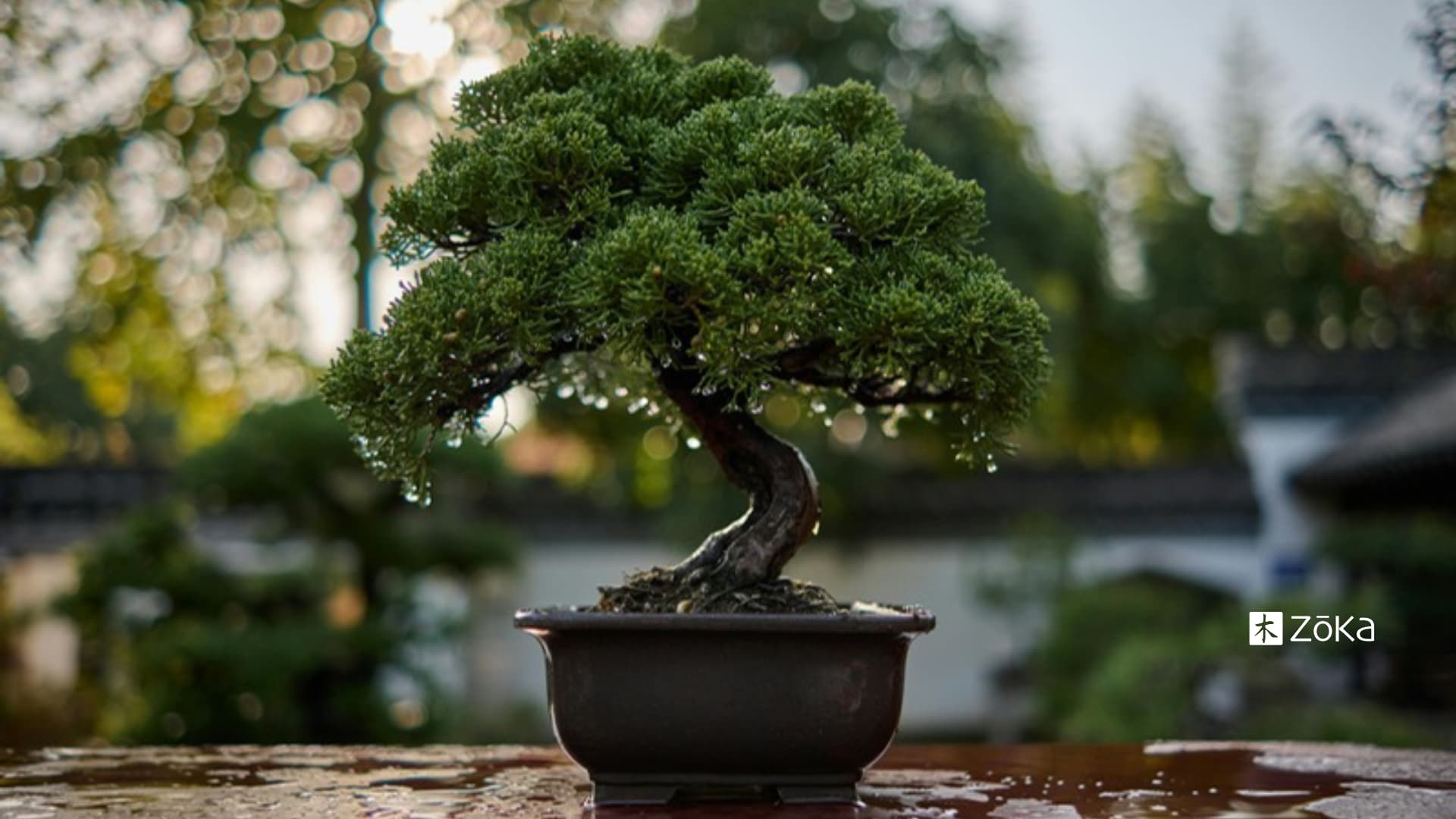
Having a bonsai in excellent condition with a beautiful and healthy appearance is truly wonderful. You feel proud of what you are doing and enjoy observing it every day, noticing how it has become the perfect companion. It is another member of the household. If you love caring for your favourite plant, you are surely ready to keep learning and improving so that it always looks spectacular.
How do you water it? Are you certain about what should be done? Watering is one of the fundamental processes for this ancient tree. That is why, at Zoka, we would like to share a brief guide with some useful tips for proper bonsai watering. Follow them and everything will go perfectly.
Put these tips for proper bonsai watering into practice!
1- Always observe the substrate: Later we will discuss adapting watering to the season of the year, which will indicate whether it should be done more thoroughly or more or less frequently, but observing the condition of the substrate is essential. You should not water automatically, but only when you notice that the substrate is dry.
If it becomes very light in colour, this is a sign that it is drying out. In any case, by placing your fingers into the substrate or using a wooden stick, you will be able to check the level of moisture inside.
2- Water thoroughly, but without overdoing it: Once it is time to water the bonsai, you should do so generously. This means that the water must come out through the drainage holes of the pot. In this way, all the roots are moistened and completely balanced growth is encouraged.
In addition, this is also very important for removing the accumulation of salts. However, do not make the mistake of watering more than necessary or too frequently. Excess moisture is one of the most common causes of bonsai death.
If you notice yellow leaves, fungi, unpleasant smells coming from the soil, or excessive leaf drop, there may be a problem.
3- Consider the season: This is another fundamental point among the tips for proper bonsai watering. To begin with, you must bear in mind that in spring the bonsai is in its growth phase, so it requires more water.
Then, during summer, you should check the substrate frequently, as the heat increases evaporation. In autumn, watering can be spaced out a little more, knowing that the plant’s growth is slower.
Finally, we come to winter, the bonsai’s resting period. This is the time when it requires the least amount of water, especially in the case of deciduous species.
4- Watering or misting: The best option for watering a bonsai is to use a watering can with very fine holes. Why? Because it ensures that the substrate does not shift and it will not damage the more superficial roots.
That said, misting can and should also be done. It greatly helps to create a sense of environmental humidity and also removes dust from the leaves. What you must understand is that this can never become a substitute for proper watering.
Have you taken note of these tips for proper bonsai watering? Always remember to know which species of bonsai you have so that you can meet its specific needs, and study the climate to which it is exposed. Now all that remains is to buy a foliar fertiliser for bonsai. Discover the spray products available in our shop. We provide exactly what you are looking for!